Symbolizing the Internal: Yorgos Lanthimos' Bugonia

Bugonia was one of the best movies of 2025, not just for its poignant sociocultural critique (see a superb analysis here - further comment unnecessary) but also for director Yorgos Lanthimos’ stylistic employment of surrealist imagery. For those who have yet to see this fantastic film, a two-sentence summary (spoiler alert): after a failed drug trial leaves his mother (Sandy, Alicia Silverstone) comatose, conspiracy theorist Teddy (Jesse Plemons) and his cousin Don (Aidan Delbis) kidnap wealthy pharmaceutical executive Michelle (Emma Stone) because he’s convinced she’s an alien. Tragedy begets tragedy and everyone ends up dead - Michelle was the alien empress all along!
Lanthimos doesn’t just tell us this story, he shows us. And not just visually, but symbolically. Lanthimos’ surrealism is a mature storytelling mechanism and rife with meaning.
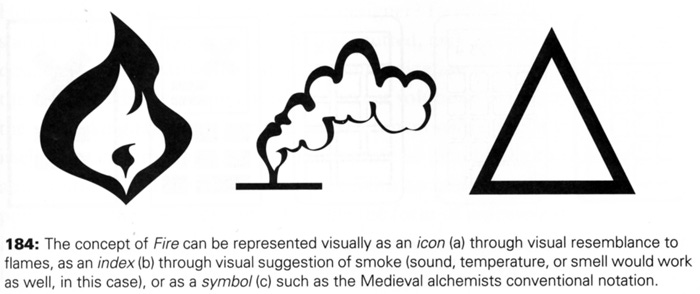
Crash course in semiotics for the uninitiated (skip this paragraph if you’re familiar): “symbolism” isn’t just a blanket term for representation but, rather, one of three levels of abstraction. An icon represents the referent (the thing being referred to) as we see it in the real world - see the image of fire on the left, below. An index abstracts the referent, implying its presence through its impact on its surroundings - see the image of smoke (implying fire might exist or have existed somewhere) in the middle, below. A symbol further abstracts, implying the referent in (some usually distant) form only - see the triangle on the right, below, suggesting the geometrical outline of a fire. Lanthimos’ artistry is in his creative use of the latter - symbolism - in a journey from construct —> decay —> rebirth.
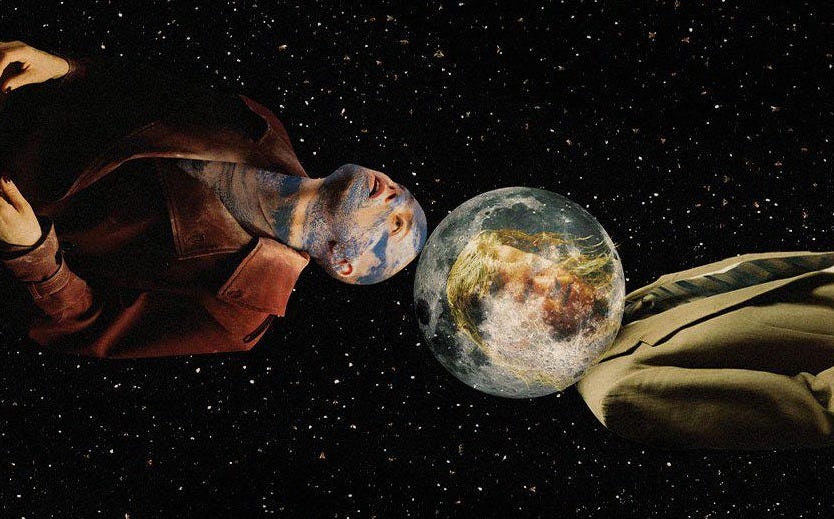
Lanthimos employs several black and white insert scenes - perhaps a flashback or, maybe, a vision of a parallel reality. Two of these stuck out to me as they involve Teddy’s mother, Sandy. She’s a victim of one of Michelle’s pharmaceutical trials, now addicted to opioids and left bedridden in a skilled nursing facility. These scenes are, in many ways, trying to tear us from reality, victimizing our sanity just as Teddy’s has been. Beyond the desaturated color palette: Teddy’s face is shaved and nearly unrecognizable, Michelle and (presumably) a team of lawyers or pharm execs are settling Teddy’s lawsuit while standing outdoors in front of Auxolith HQ, and Sandy is floating higher and higher in mid-air.
In one scene, Teddy holds Sandy’s IV tubing like the string of a balloon, tethering her to earth. Is this a commentary on the selfish emotionality of surrogate decision-making in hospice care? Teddy won’t let her go and he looks like a child clinging to his balloon while doing so. Or is it more hopeful? The alien mothership floats in outer space. Michelle explains that alien experiments (including that of Teddy’s mother) are attempts to save humanity - she floats closer to absolution, heaven, an ultimate or evolved form. Here, surrealism is constructed.
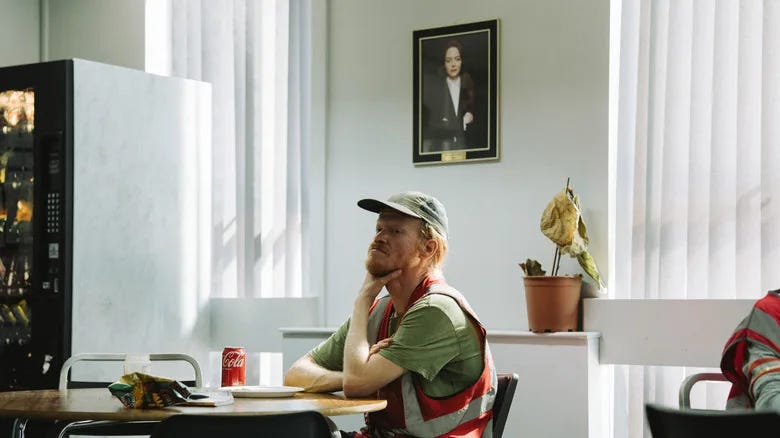
Both Teddy and Michelle’s environments are surreal in a sense, too. Michelle’s home (and, by extension, office) are ultra-modern and spaceship-like whereas Teddy’s is frozen in time, rotting, reminiscent of an era long gone. Michelle is far different from Teddy and this contrast shows clearly in their surroundings. Michelle cannot maintain a facade: her attempt at a DEI presentation video is comically performative; her home is bare and unlived-in, mostly glass and reflective surfaces; her office is a giant glass box - translucent - with privacy curtains that practically invite prying eyes; Teddy sees her alienness plainly and externalizes it for others to see by shaving her head and coating her skin in a white antihistamine cream.
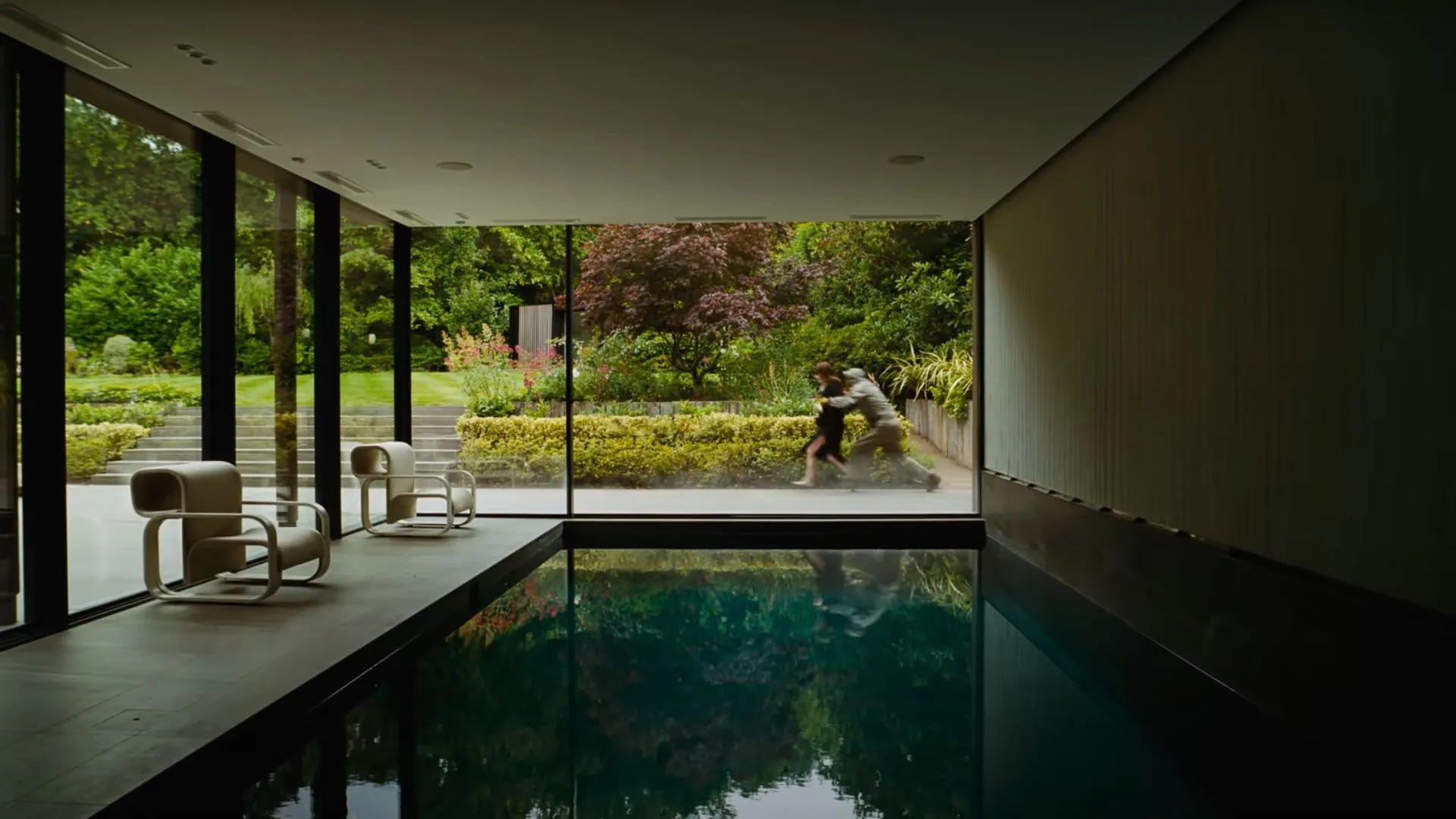
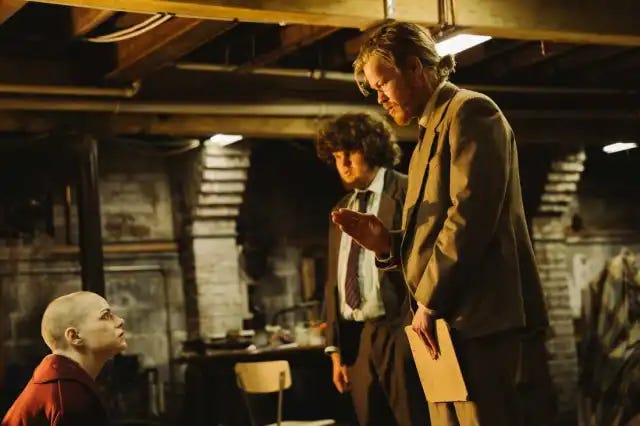
The surreality of Michelle’s environment is a level of wealth with which we’ll never be familiar whereas the surreality of Teddy’s environment is the externalization of his brokenness. It’s easy to miss as Teddy’s house is indeed familiar, cozy. Michelle discovers the secret room adjacent to his basement, which production designer James Price describes as “the inner sanctum of where this whole conspiracy has been borne out.” Most Americans (or perhaps this is a global phenomenon?) endure Teddy’s psychopolitical-conspiratorial decline unseen, in silence, whereas we see Teddy’s externalized as a petrified human head in a jar. Now the surrealist imagery suggests decay.
Once Michelle ascends, returning to the mothership, we see the Andromedans in their true form. Their environment is organic-looking, the ship’s structure mirrors human internal anatomy, and their garb looks… cozy? Large, cable-knit onesies that look more homemade than alien. Price describes finding inspiration in “birth and rebirth.” The ship’s throne room feels like a sacred temple, centering a pool of Pepto Bismol-appearing liquid: the “womb” through which humanity (Andromedanity?) would be (could be) reborn.
Lanthimos is clearly commenting on our nature: either who we are or, at least, who we are right now. In fact, nature is the controlling factor: one of Teddy’s first grievance signals is colony collapse disorder, Casey’s (Teddy’s rapist and local police officer) death is catalyzed in part by bees, animals ultimately outlive the human race. We can try to control (our) nature with neonicotinoids but nature is cruel, uncaring, vengeful. But the dogs and cats and birds live on: rebirth, hope.
Teddy's belief in the other-wordliness of his political victmization is shown through the unexplained surrealism of his mother's illness. I wasn't sure if we were seeing her floating from his mental illness mired memory or if that's actually what happened.
Everything in this essay was food for thought! I really enjoy it and you've really made me appreciate Lanthimos not just as a director but as a prominent contemporary surrealist! Very good write up!!!
🙈😄💪🏻 I'm so glad my post inspired this!!!